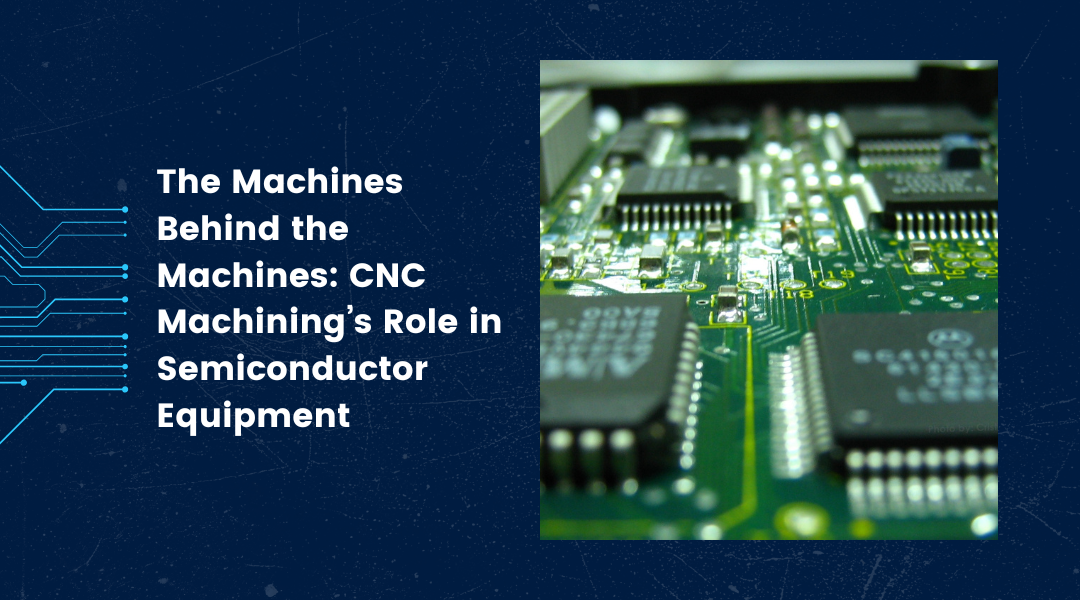
Silicon Valley has always been about pushing limits. Right now, thatmeans building smaller, faster, and more powerful chips. But behindevery semiconductor breakthrough is something most people never see:the precision-machined components that make the equipment possible inthe first place.
Before a wafer ever enters a chamber, before a lithography systemexposes a circuit, or before a deposition tool lays down material atthe atomic level, somebody had to machine the components those systemsrely on. That’s the kind of work we do every day.
Semiconductor Equipment Is a Different Animal
The parts used in semiconductor equipment aren’t your average machinedcomponents. Vacuum chambers, wafer-handling systems, manifolds,structural frames, motion plates — these parts all require extremelytight tolerances and demanding surface finishes. In many cases, asmall imperfection isn’t just a cosmetic issue. A leak path in avacuum chamber or contamination from poor machining practices canimpact an entire process.
Cleanliness matters just as much as dimensional accuracy. Many ofthese parts have to be machined, handled, and packaged in ways thatminimize particle generation and contamination. Material selection,tooling strategies, workholding, surface finish, and post-processingall play a role in getting it right.
And when you think about what semiconductor equipment is actuallydoing — operating at microscopic and even atomic scales — it makessense why the machining standards are so high.
Why Being Local Still Matters
There’s a reason so much semiconductor equipment development happensin Silicon Valley. Companies like Applied Materials, Lam Research, andKLA are all here, along with a massive network of suppliers,engineers, and manufacturing partners.
When engineering teams need prototype parts quickly, they don’t wantto wait weeks for components to ship across the country or overseas.They need fast turnaround, direct communication, and the ability tosolve problems quickly when designs inevitably change.
That’s one of the advantages of being based in Santa Clara. We canmove quickly, work directly with engineering teams, and get parts fromour shop floor to local facilities in a matter of hours — not weeks.
In semiconductor manufacturing, responsiveness isn’t a luxury. It’spart of keeping projects moving.
What These Parts Demand From a Machine Shop
A lot of semiconductor components require advanced multi-axismachining. Complex geometries, intersecting features,precision-located bores, and tight positional tolerances often make4-axis and 5-axis machining essential.
The goal is to keep parts in as few setups as possible. Every time apart gets repositioned, you introduce potential tolerance stack-up.Single-setup machining helps maintain accuracy and consistency,especially on complex assemblies.
And the parts are rarely simple.
Material knowledge matters just as much as machine capability.Aluminum is widely used throughout semiconductor equipment because ofits machinability and strength-to-weight ratio, but the exact alloy,temper, and finishing process matter. Some components require hardanodizing with tightly controlled buildup. Others require extremelyfine surface finishes measured in microinches.
Holding tolerances is important. Understanding how the entiremanufacturing process affects the final part is what really matters.
Quality Systems Matter
Semiconductor OEMs expect strong quality systems from their suppliers,and for good reason. These tools process wafers worth hundreds ofthousands of dollars. There’s very little room for inconsistency.
Traceability, inspection documentation, and process control aren’tjust paperwork. They’re critical to maintaining reliability andrepeatability.
At Euro Machining, our ISO 9001 certification reflects the systemswe’ve built around quality and consistency. Every part is backed byinspection documentation, and our focus is making sure the parts wedeliver match exactly what was quoted and engineered.
Supporting the Industry That Builds the Future
The semiconductor industry moves fast, and the equipment behind itkeeps getting more advanced. As chip architectures shrink andprocesses become more complex, the demand for precision-machinedcomponents only increases.
That’s exactly the kind of work we’re built for.
Whether it’s prototype development, quick-turn production machining,or complex multi-axis components for semiconductor equipment, weunderstand the level of precision and responsiveness these programsrequire.
If your team is looking for a machining partner for semiconductorequipment components, we’d be happy to talk.