As a precision machine shop, we make components that end up in some impressive applications. Our parts are used in semiconductor equipment, aerospace assemblies, medical devices, and other advanced systems. Most of the time, however, we never get to see the finished product in operation.
This project was a little different.
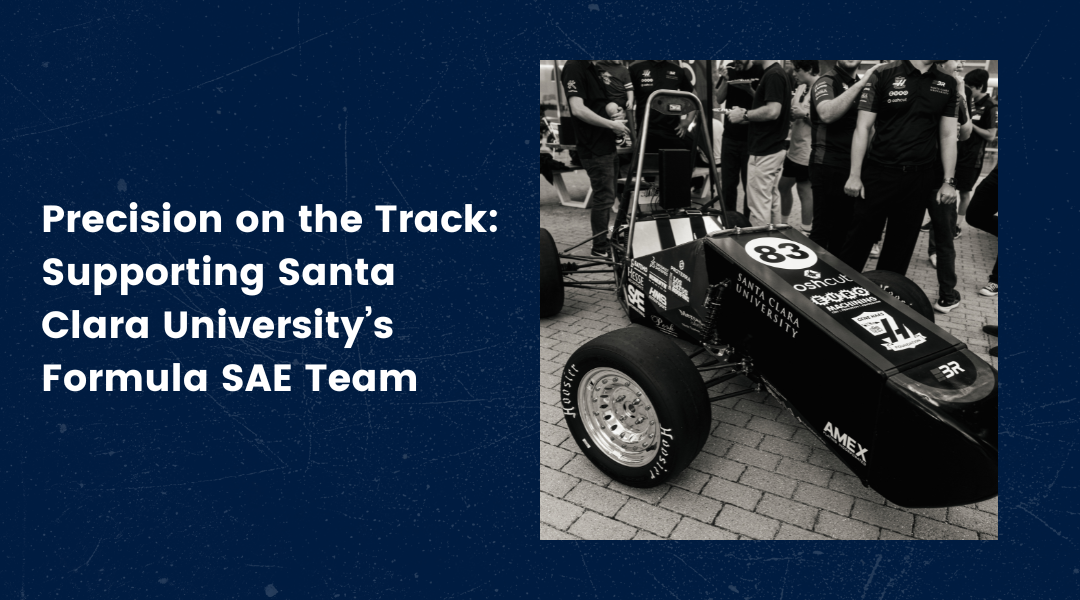
Earlier this year, Euro Machining had the opportunity to support the Santa Clara University Formula SAE team with precision-machined components for its student-built race car. Later, we learned that the team had placed the Euro Machining name on the car.
We were proud to see it—not simply because our logo was displayed, but because of what the car represented: months of engineering, manufacturing, problem-solving, teamwork, and determination by a talented group of students.
What Is Formula SAE?
Formula SAE is a collegiate engineering competition in which students design, manufacture, assemble, test, and race an open-wheel formula-style car.
The students are responsible for nearly every aspect of the vehicle, including the chassis, suspension, steering, braking, drivetrain, electronics, and overall vehicle performance. They must balance weight, strength, manufacturability, cost, reliability, and safety while working within detailed competition rules.
It is much more than a classroom project. The parts are subjected to real loads, vibration, heat, and stress. The students also know that one of their own teammates will ultimately be driving the car.
That means the components must be manufactured correctly. Dimensions, tolerances, materials, and fit all matter. There is very little room for “close enough.”
Helping Turn Their Designs Into Parts
The Santa Clara University team contacted us for help manufacturing components for its build, and we were happy to support the project.
University engineering teams often develop very capable designs but may not have access to the equipment, fixturing, inspection tools, or manufacturing experience available to established engineering companies. That is where a local manufacturing partner can make a meaningful difference.
Our role was to help turn the students’ designs into finished components that met their requirements and could be installed with confidence.
Working with the team was also a positive experience for us. The students came prepared, understood their designs, asked good questions, and were serious about producing a successful car. Their attention to detail was similar to what we see from many of the professional engineering teams we work with every day.
A Meaningful Thank-You
When we found out that the team had included the Euro Machining name on the car, it was an unexpected and greatly appreciated gesture.
This race car represented a large portion of the students’ academic year. They spent countless hours designing, machining, assembling, troubleshooting, testing, and improving it. Having our company associated with that effort was something our entire team could be proud of.
We were glad to contribute and even happier to see the finished car come together.
Supporting the Next Generation of Engineers
Euro Machining has been part of the Santa Clara and Silicon Valley manufacturing community for many years. This area depends on talented engineers who understand not only how to design a component, but also how that component will actually be manufactured, inspected, assembled, and used.
Programs such as Formula SAE give students valuable hands-on experience that cannot be gained from textbooks alone. They learn how design decisions affect machining, cost, lead time, strength, assembly, and performance. They also learn how to work through the challenges that come with taking an idea from a computer screen to a functioning vehicle.
Those lessons will remain valuable long after the competition is over.
We are proud to have supported the Santa Clara University Formula SAE team and look forward to seeing where these young engineers go next.
For engineering teams and companies looking for an experienced partner for precision CNC machining, contact Euro Machining at (408) 845-9300 or learn more about our capabilities at euromachining.com/.