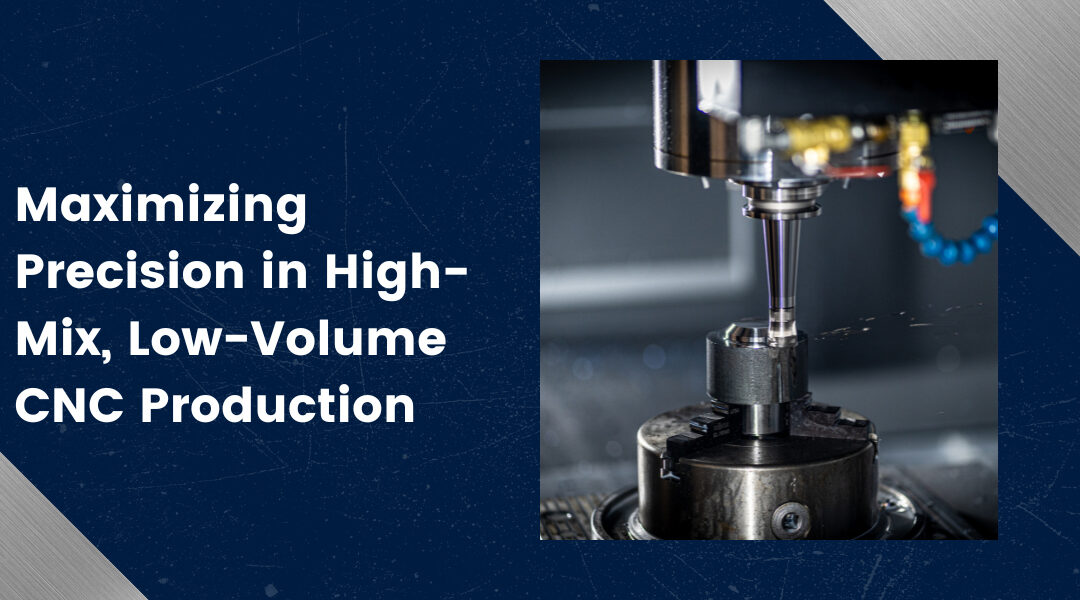
Out here in Silicon Valley, product development moves fast. One week it’s a CAD model, the next week an engineer needs real parts on the bench for testing. In aerospace, medical, and semiconductor work, the challenge is not just finding a machine shop that can “make the part.” It’s finding a shop that can handle high-mix, low-volume production while still holding the tight tolerances your project depends on.
That’s the world we live in at Euro Machining.
A lot of shops are built around long production runs. Thousands of identical parts. Same setups. Same tooling. That works great until your project needs ten complicated parts, multiple revisions, and turnaround times that actually matter. High-mix, low-volume manufacturing is a completely different game.
When you’re machining ten complex titanium manifolds instead of ten thousand simple brackets, every setup matters. Every fixture matters. Every conversation matters. One missed dimension or one inefficient setup can completely change the economics of the project.
That’s why we approach HMLV work differently.
High-Mix Manufacturing Requires Flexibility
At our Euro Machining facility, we regularly move between completely different industries and materials throughout the day. Aerospace titanium in the morning. Stainless medical components after lunch. High-purity plastics for semiconductor equipment later that evening.
That kind of environment forces you to build systems around flexibility and repeatability.
We invest heavily in modular fixturing, standardized tooling strategies, and optimized CAM workflows so setup time doesn’t kill efficiency. In low-volume manufacturing, reducing setup time is often more important than shaving a few seconds off cycle time.
For engineering and R&D teams, this matters a lot.
If you’re iterating prototypes, you don’t want to wait three weeks every time you revise a feature or move a hole location. You need a machining partner that can pivot quickly without turning every revision into a major production event.
That agility is where a good HMLV shop separates itself.
Precision Is More Than Just Machining
A part can come off the machine perfectly and still fail later because of handling, secondary processing, or assembly issues.
That’s something we see constantly in the industry.
A component gets machined at one vendor, sent somewhere else for hardware installation or sub-assembly, then moved again for inspection. Every transfer introduces risk — scratches, tolerance stack-up, delays, or communication breakdowns.
We try to eliminate as much of that as possible by handling assembly and fitment verification in-house whenever it makes sense.
To us, assembly is not an “extra service.” It’s part of the manufacturing process.
If hardware needs to press correctly, if mating parts need to align properly, or if a subassembly needs to function the moment it reaches the customer, we want to verify that before it leaves our building.
That saves time, reduces headaches, and gives customers a part that is actually ready to use instead of just “machined.”
Bridging the Gap Between Prototype and Production
One of the biggest mistakes companies make is treating prototype machining and production machining as completely separate phases.
That usually creates problems later.
We spend a lot of time helping customers think through manufacturability early, even on low-volume jobs. Sometimes that means adjusting tolerances that are unnecessarily tight. Sometimes it means changing a corner radius, thread callout, or workholding strategy before the first chip is even cut.
Those small conversations upfront can save thousands of dollars later.
Our goal is not just to get five prototype parts out the door. It’s to help customers build a process that can scale cleanly when they need fifty, a hundred, or more.
That’s especially important in aerospace, defense, and medical work where documentation, consistency, and repeatability matter just as much as the machining itself.
At the end of the day, a good machine shop should feel like an extension of your engineering team — not just another vendor in the supply chain.
If you’re working on a high-precision project and need a shop that understands high-mix, low-volume manufacturing, reach out to Euro Machining. We’d be happy to review your prints, talk through manufacturability, and help you get parts moving quickly.